

 English
 日本語
 Español



Deng Caiwei — International Sales Manager

Home / Author / Deng Caiwei — International Sales Manager / Why a Japanese-Style Three-Fold Gel Memory Foam Mattress Is a Practical Choice for Modern Sleep Spaces
Product Category
NEW Category
Contact us
Why a Japanese-Style Three-Fold Gel Memory Foam Mattress Is a Practical Choice for Modern Sleep Spaces
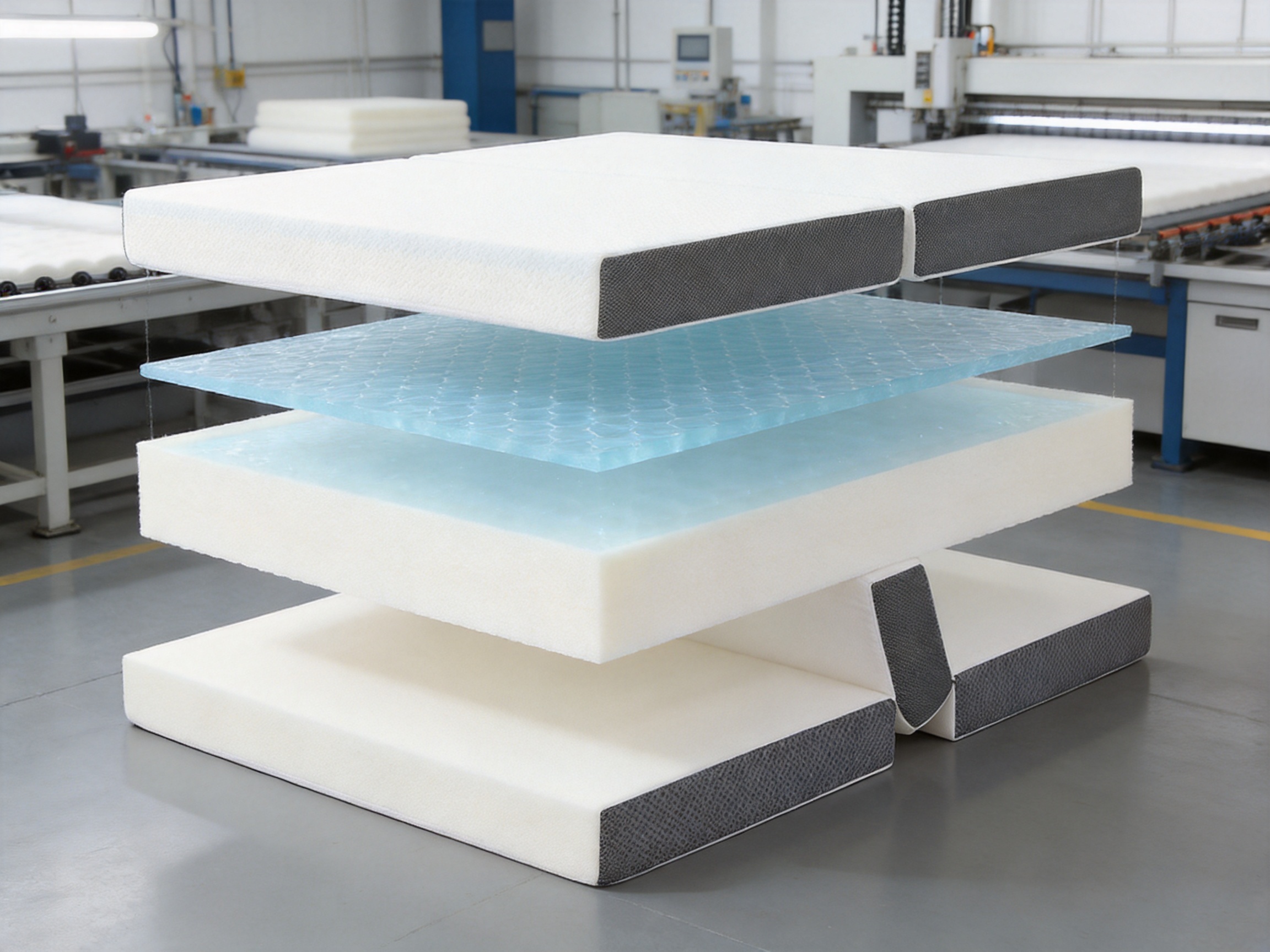
As homes become more compact and lifestyles become more flexible, consumers are looking for sleep products that combine comfort, support, portability, and efficient use of space. A mattress is no longer expected to serve only one fixed bedroom. It may need to work in a guest room, rental apartment, children’s room, office, guesthouse, travel setting, or temporary sleeping area. The Japanese-style three-fold memory foam gel mattress is designed around this changing demand.
This mattress combines high-density slow-rebound foam with a gel layer to create a supportive and breathable sleeping surface. Its three-fold structure allows it to be opened as a full sleeping mat and folded into a compact shape for storage or transport. The minimalist white-and-gray appearance makes it suitable for modern interiors, while the non-slip fabric helps keep the mattress more stable during use.
Manufactured by Jiangsu Wellcare Household Articles Co., LTD., the product reflects the company’s long-term focus on foam material research, product development, and healthy home solutions. Since its establishment in 2003, the company has built experience in ordinary sponge, memory foam, gel foam, temperature-insensitive memory foam, quick-dry memory foam, flame-retardant sponge, antibacterial sponge, and other foam materials. This technical background is important because the performance of a folding mattress depends not only on its outer cover, but also on the quality, density, formulation, and structural design of its internal materials.
The result is a versatile tri-fold memory foam mat intended for people who want the pressure-relieving characteristics of memory foam without committing to a bulky, permanently installed mattress. It offers a balance between everyday comfort and practical storage, giving it several advantages over conventional mattresses, thin sleeping pads, and basic folding foam mats.
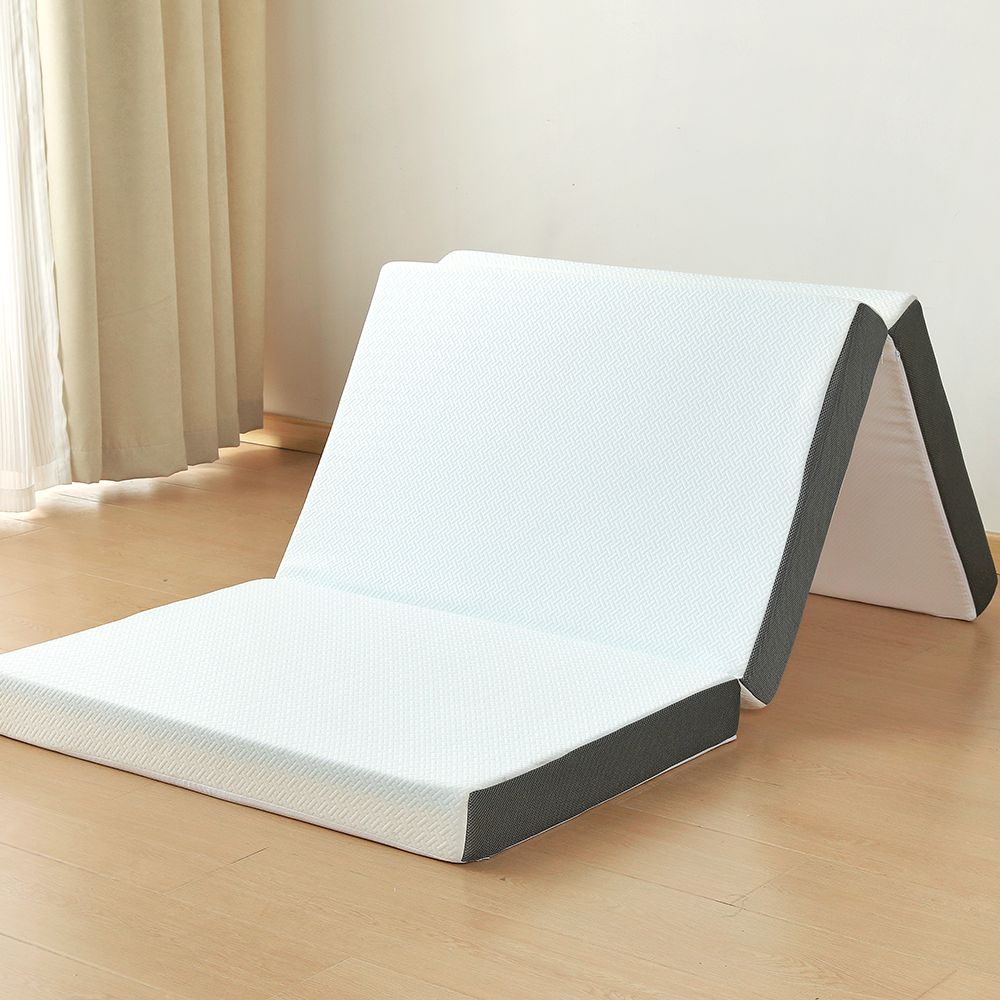
Japanese-style three-fold memory foam gel mattress
Product Overview and Intended Use
The Japanese-style three-fold memory foam gel mattress is a 150-millimeter-thick folding sleep product made primarily from memory foam and polyester fiber fabric. Its internal construction combines a regular foam support layer with a higher-density memory foam layer, while the gel component is designed to improve heat dissipation and reduce the warm, enclosed feeling that some users associate with foam bedding.
The product is available in configurations described as white 10-centimeter thickness and white 5-centimeter thickness, with the material structure listed as 25D regular foam combined with 40D memory foam. The product information also identifies a 150-millimeter thickness specification. Because product options and listing terminology can vary by market, buyers and distributors should confirm the exact thickness, foam combination, and size before placing an order.
Listed dimensions include a length of approximately 190 centimeters and widths of approximately 63.5 centimeters or 96 centimeters, depending on the selected version. The product is associated with a 1.0-meter bed size and is suitable for use as a single sleeping surface, guest mattress, floor mattress, nap mat, or temporary bed. Its tri-fold design divides the mattress into three connected sections, allowing it to be folded without removing or assembling separate parts.
The mattress is intended for several environments:
• Primary bedrooms where an additional flexible sleeping surface is needed.
• Guest rooms that require a mattress that can be stored when visitors are not present.
• Rental apartments where floor space and storage space are limited.
• Guesthouses and hospitality settings that need easy-to-handle bedding.
• Offices and studios where staff may need a comfortable nap surface.
• Travel, temporary accommodation, and relocation situations.
• Floor-based sleeping arrangements influenced by Japanese and minimalist interior styles.
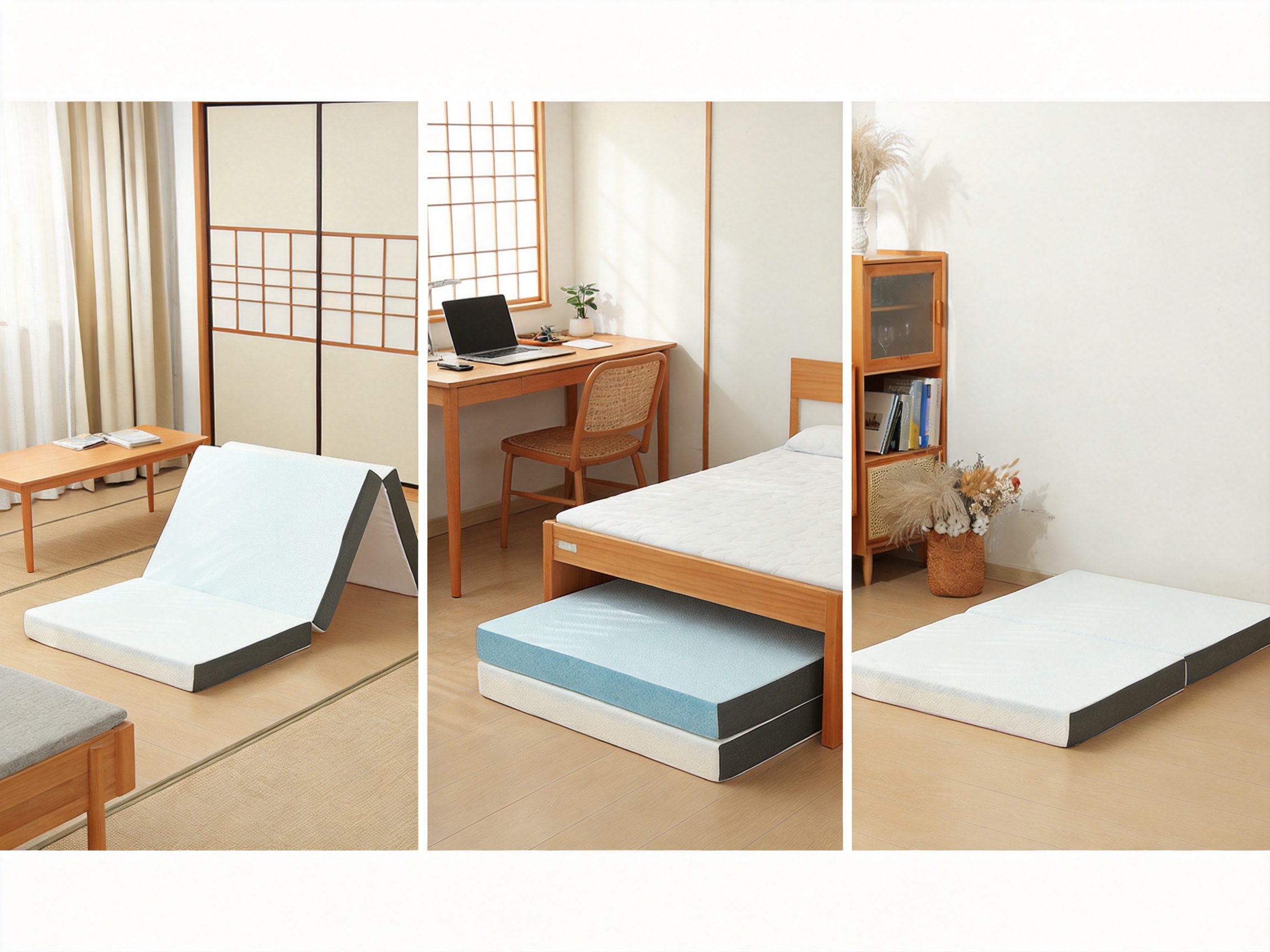
Unlike a conventional innerspring mattress, this product does not require a bed frame or installation. It can be unfolded on a clean, level surface and used almost immediately after unpacking and airing. When not needed, it can be folded and placed under a bed, inside a cabinet, against a wall, or in another suitable storage area.
High-Density Slow-Rebound Foam for Pressure Distribution
The main comfort feature is the slow-rebound memory foam layer. Memory foam is a viscoelastic material that responds to pressure and body heat. When a person lies on the mattress, the foam gradually compresses around areas such as the shoulders, hips, and back. This helps spread contact pressure over a broader surface instead of concentrating it at a few high-load points.
A well-designed memory foam mattress should provide a balance between conformity and support. If the material is too soft, the sleeper may feel unstable or experience excessive sinking. If it is too firm, the surface may not relieve pressure effectively. The listed combination of 25D regular foam and 40D memory foam is intended to create a layered structure in which the regular foam contributes base support while the memory foam provides a more adaptive comfort surface.
The high-density construction also supports shape retention. Repeated folding, unfolding, and daily use place demands on the foam. A mattress used in a guest room may be stored for long periods and then opened quickly. A mattress used in an office or apartment may be folded every day. Foam with appropriate density and resilience is better suited to this repeated handling than an extremely soft or low-density material.
Memory foam cannot eliminate every source of discomfort, and personal sleeping preferences vary. However, its pressure-distribution behavior can be beneficial for sleepers who prefer a cushioning surface that conforms more closely than a basic cotton mat or thin polyurethane pad. The mattress may also reduce the sensation of hard flooring beneath the body when used on a suitable flat surface.
For side sleepers, the conforming surface can help cushion the shoulder and hip areas. For back sleepers, the foam may provide a more even contact pattern around the lower back and pelvis. For occasional sleepers, the material offers a more substantial feel than a lightweight camping pad. The best result depends on body weight, preferred firmness, room temperature, and the supporting surface beneath the mattress.
Gel Layer for a Cooler Sleeping Experience
Traditional memory foam is often praised for its comfort but criticized for retaining heat. Because the material closely surrounds the body, airflow at the contact surface can be limited. In warm climates or poorly ventilated rooms, this may create an uncomfortable sensation during extended use.
The gel layer in this mattress is designed to address part of that concern. Gel materials can help distribute and dissipate heat more effectively than foam alone. By incorporating gel into the composite structure, the mattress aims to provide a cooler and more breathable sleeping experience while preserving the pressure-relieving behavior of memory foam.
The gel layer is not a replacement for proper room ventilation, moisture control, or breathable bedding. Nevertheless, it can contribute to a more balanced surface environment. This feature is particularly relevant for users in Southeast Asia, warm North American regions, and other climates where nighttime temperatures remain high for much of the year.
The combination of slow-rebound foam and gel gives the product a competitive advantage over basic folding mats made solely from standard foam. A conventional foam mat may be lightweight and inexpensive, but it may not provide the same degree of body conformity or thermal management. Conversely, some traditional memory foam mattresses may offer good contouring but lack a folding structure or cooling layer.
By integrating both functions, the product is positioned between a simple portable mat and a full-size premium mattress. It aims to provide a more comfortable experience without losing the convenience expected from a folding product.
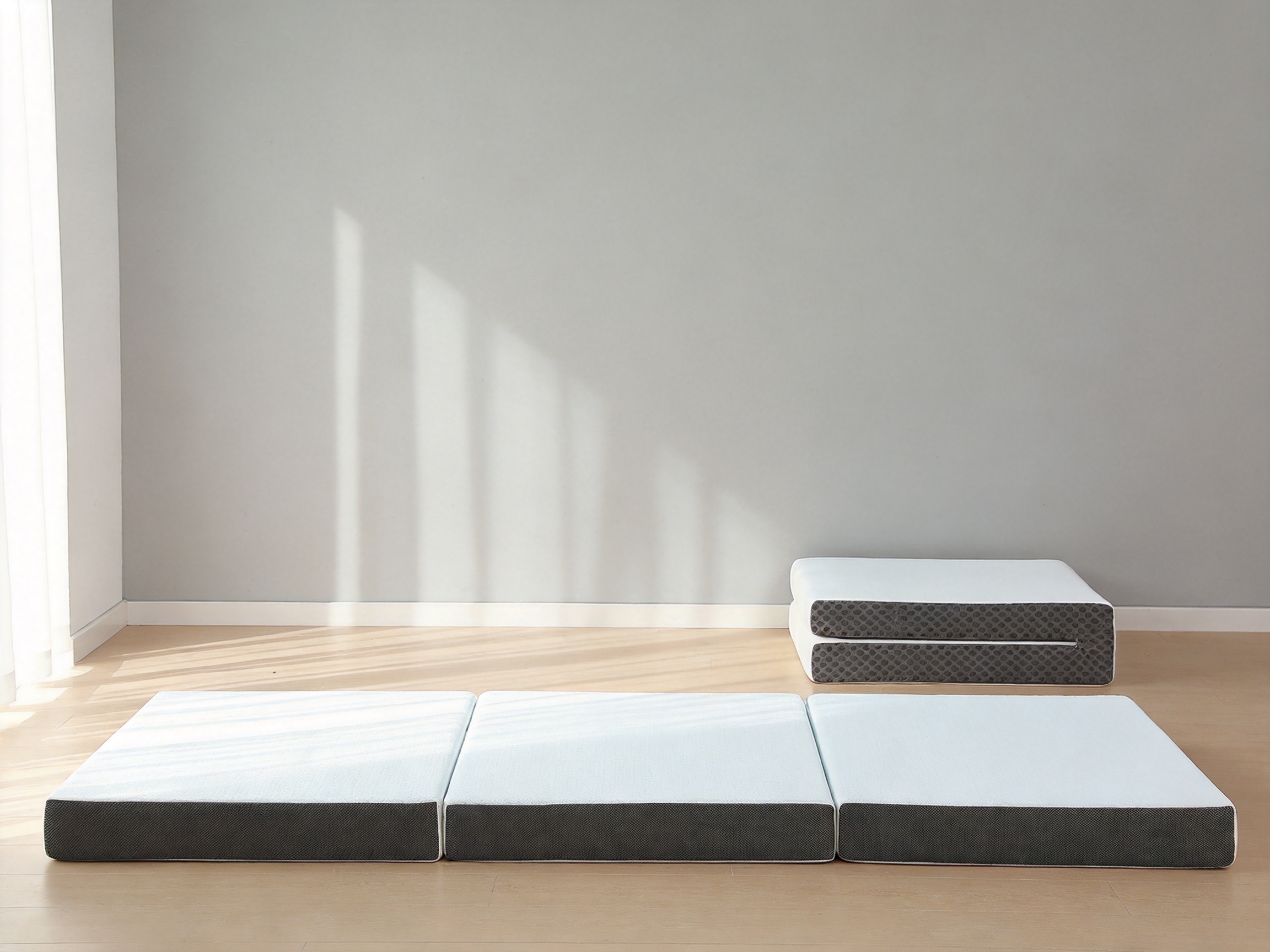
Three-Fold Construction and Space Efficiency
The three-fold design is one of the product’s clearest practical advantages. A conventional mattress usually occupies a fixed area and is difficult to move without assistance. A roll-up mattress may be portable but can require time to roll tightly and may not provide a stable folded form. A tri-fold mattress offers a different solution: each section remains connected, and the entire item can be folded into a compact, organized package.
When opened, the three sections create a continuous sleeping surface. When folded, the sections stack over one another, reducing the amount of floor area required for storage. This makes the mattress suitable for small apartments, studio rooms, dormitory-style accommodation, multifunctional bedrooms, and homes where a room must change purpose during the day.
For example, a living room can function as a sitting area during the day and a guest room at night. A home office can be converted into a temporary sleeping space without moving a heavy bed frame. A guesthouse can store several folded units in a designated closet rather than dedicating a large room to permanent bedding. In a rental property, a portable mattress can be moved between rooms or taken to a new residence without the logistical difficulty associated with a traditional mattress.
The folding structure also helps with transportation. The mattress can be carried through narrow hallways, staircases, elevators, and doorways more easily than a full-size mattress. This is useful for individual consumers, retailers, hospitality operators, and property managers. Its manageable format can reduce handling time during room turnover, relocation, or seasonal storage.
Storage under a bed is another important benefit. Many homes have unused space beneath a bed frame, and a folded tri-fold mattress can be placed there when not in use. It may also stand vertically in a closet or corner, provided the storage area is dry, clean, and large enough to avoid damaging the fabric or foam.
In comparison with inflatable mattresses, a foam folding mattress does not require an electric pump or manual inflation. It does not depend on an air chamber remaining fully sealed, and it is ready for use without the noise or preparation associated with inflation. Compared with a roll-up sleeping mat, its three-part structure offers a more stable folded form and may be easier to stack or organize.
Minimalist Appearance and Everyday Compatibility
The outer design uses a white surface with dark gray edging. This color combination creates a clean, understated appearance that can blend with bedrooms, guest rooms, office interiors, and modern hospitality environments. The design is intentionally simple rather than decorative, allowing it to function as bedding without visually overwhelming a room.
The white surface gives the mattress a fresh and uncluttered appearance, while the darker edging helps define the mattress perimeter and gives the product a finished look. The contrast can also make the folding sections easier to identify. As with any light-colored textile product, regular care is important. Users should follow the cleaning instructions provided with the specific product version and avoid saturating the foam core.
The fabric material is listed as polyester fiber. Polyester is commonly used in mattress covers because it is durable, relatively easy to maintain, and suitable for repeated handling. The surface is also described as non-slip, which can help reduce unwanted movement when the mattress is placed on a suitable floor or platform.
A non-slip surface is especially valuable for floor sleeping, guest use, and office naps. It can help the mattress remain in position as a sleeper changes posture. However, the product should still be placed on a clean, dry, level surface, and users should check the environment for hazards such as loose rugs, moisture, sharp objects, or uneven flooring.
Comparison with Other Mattress Types
| Product Type | Main Strength | Common Limitation | Advantages of the Three-Fold Gel Memory Foam Mattress |
| Traditional Innerspring Mattress | Strong structural support and familiar feel | Heavy, bulky, and difficult to store or move | More portable, foldable, and suitable for temporary or multifunctional spaces |
| Basic Foam Folding Mat | Lightweight and economical | May offer limited pressure relief and heat management | Combines slow-rebound memory foam with a gel layer for adaptive comfort and improved heat dissipation |
| Inflatable Mattress | Compact when deflated | Requires inflation and may lose air or feel unstable | Ready to use without a pump and provides a solid foam sleeping surface |
| Roll-Up Floor Mat | Easy to carry and roll | May provide less structure and less cushioning | Three connected folding sections create a practical storage shape and substantial support |
| Fixed Memory Foam Mattress | Comfortable long-term sleeping surface | Usually difficult to move and cannot be compactly stored | Offers memory foam comfort in a flexible, space-saving format |
| Thin Camping Pad | Very lightweight and portable | Limited thickness and pressure relief for extended sleeping | Provides a thicker, more home-oriented surface for guests, naps, and temporary beds |
The comparison shows that the product is not designed to replace every type of mattress in every situation. A permanently installed mattress may be preferable for someone seeking a dedicated primary bed with a specific support system. A very thin camping pad may be more suitable for ultralight outdoor travel. However, the tri-fold gel memory foam mattress occupies a useful middle position for users who prioritize flexibility.
Its competitive value comes from combining several features that are often sold separately: memory foam conformity, gel-assisted cooling, a folding form, non-slip fabric, a modern appearance, and a relatively substantial profile. Consumers do not have to choose exclusively between comfort and portability. The product is intended to make both characteristics available in one mattress format.
Benefits for Residential and Commercial Users
For residential consumers, the mattress can function as an extra bed without requiring a permanent guest bed. Families can store it for visitors, use it during home renovations, or place it in a child’s room for occasional rest. It may also be useful when a household member is recovering from illness or injury and needs a temporary sleeping arrangement on a different floor or in another room. Medical advice should always be followed for specific recovery needs, but the flexible format can make room changes easier.
In rental apartments, storage efficiency is often a priority. Residents may not want to invest in a large mattress that is difficult to transport when moving. A foldable product reduces the burden of relocation and can be used in rooms with multiple purposes. Students, young professionals, and people living in temporary accommodation may appreciate this adaptability.
For guesthouses and small hospitality businesses, folding mattresses can simplify room preparation. A unit can be brought into a room only when needed, allowing operators to respond to changing occupancy. The manageable format may also make housekeeping and storage more efficient. As with all hospitality bedding, cleaning procedures, cover protection, and replacement schedules should be established according to local operating requirements.
Offices, studios, and wellness spaces can use the mattress for short rest periods. A supportive mat is more comfortable than a bare floor and more convenient than a full bed. When the rest period ends, the unit can be folded away to restore the working area.
Retailers and distributors may also find the product suitable for different sales channels. The product information identifies eBay, Amazon, Wish, AliExpress, independent sites, and Lazada as downstream platforms, with Europe, Southeast Asia, and North America listed as major sales regions. Its clear value proposition is easy to communicate: a foldable memory foam mattress with gel cooling, intended for space-conscious modern living.
Material Innovation and Manufacturing Background
A folding mattress is only as reliable as the materials and production controls behind it. The manufacturer, Jiangsu Wellcare Household Articles Co., LTD., has focused on foam materials and healthy home products for many years. The company’s background includes research and development of ordinary sponge, memory foam, gel foam, temperature-insensitive memory foam, quick-dry memory foam, flame-retardant sponge, antibacterial sponge, and other formulations.
This range of material experience is significant because foam performance depends on formulation and processing. Density, resilience, compression response, recovery speed, cell structure, durability, temperature behavior, and compatibility with other layers all influence the user experience. A manufacturer that works across multiple foam categories can draw on broader technical knowledge when developing a composite sleep product.
The company states that it is led by a doctor-led research and development team and develops more than one hundred new foam materials each year. This indicates an ongoing emphasis on formulation development rather than reliance on a single conventional foam recipe. For customers seeking customized foam solutions, this R&D orientation can support the development of products with different firmness levels, thicknesses, thermal properties, or functional characteristics.
The company’s development history began in 1993 as a school-run scientific research enterprise. In 2003, it purchased a 12,000-square-meter factory building and jointly developed a new sponge material with Huai’an Institute of Technology. In 2008, it purchased 50,000 square meters of land. These milestones show a gradual transition from research-oriented activity toward expanded industrial manufacturing.
By 2010, the company reports that its products were supplied to cross-border supermarkets in the United States, Germany, and Japan. It later expanded exports to the United Kingdom, Canada, Australia, and Kuwait. In 2018, it became an Alibaba-certified Gold Supplier and entered e-commerce, and in 2020 it became a designated supplier for five-star hotels. These experiences suggest familiarity with different market expectations, product specifications, and supply requirements.
Manufacturing capability is particularly important for a product that may be customized. The product information identifies custom processing as available and cross-border export supply as supported. Buyers can therefore discuss requirements such as dimensions, thickness, cover configuration, packaging, labeling, or market-specific product details with the manufacturer, subject to confirmation of feasibility and minimum order conditions.
Foam Production and Composite Structure
The product’s performance begins with the preparation of its foam materials. Regular support foam and memory foam must be produced with consistent formulation and controlled physical properties. For a composite mattress, the layers must work together rather than behave as unrelated materials. The support foam should provide a stable foundation, while the memory foam should respond gradually to pressure and help cushion the body.
The listed 25D regular foam and 40D memory foam construction suggests a differentiated layer design. Density alone does not determine quality, but it is an important indicator of material structure. Higher-density memory foam generally contains more material within a given volume and may provide a more substantial feel and better resistance to premature deformation than low-density alternatives. Actual performance also depends on formulation, cell structure, curing, thickness, temperature, and manufacturing control.
The gel layer adds another functional component. It must be integrated into the mattress in a way that supports thermal management without creating uncomfortable hard spots or reducing the flexibility of the folding sections. Proper layer design helps preserve a smooth sleeping surface while allowing the gel component to contribute to heat dissipation.
After the foam materials are produced, they must be cut to consistent dimensions. Accurate cutting is especially important in a tri-fold mattress because the three sections need to align correctly. Uneven section sizes can affect folding, storage, appearance, and sleeping comfort. Consistent edges also help the outer cover fit properly and maintain a neat appearance.
The sections must be joined in a manner that allows repeated folding without excessive strain on the cover or connecting areas. The folding points should remain flexible while the opened mattress should feel sufficiently continuous for normal use. Quality control at this stage may include checking section alignment, overall dimensions, surface flatness, folding action, and cover fit.
The cover is then fitted around the foam structure. Polyester fiber provides a practical textile surface, and the non-slip bottom or contact surface is intended to improve stability. Dark gray edging helps reinforce the perimeter and gives the mattress a finished visual profile. Seams, closures, edging, and contact surfaces should be inspected for consistency before packaging.
Quality Control Considerations
Quality control for a memory foam folding mattress should cover both material performance and finished-product usability. Important checks may include foam density, thickness, rebound behavior, dimensional tolerance, surface flatness, odor after production, cover workmanship, zipper or closure function where applicable, color consistency, and folding alignment.
Because the mattress is designed for repeated storage and movement, folding durability is also relevant. The product should be opened and folded carefully according to the manufacturer’s guidance. Excessive bending, sharp creasing, compression under heavy objects, or storage in damp conditions can reduce the useful life of any foam product.
Packaging is another important part of manufacturing and distribution. The mattress may be compressed or packaged for transport, depending on the selected supply configuration. After unpacking, foam products often need time to recover their intended shape and release manufacturing or packaging odors. Buyers should follow the supplier’s instructions regarding ventilation, recovery time, and initial use.
Export products also require attention to carton dimensions, labeling, shipping protection, and destination-market requirements. The product information includes outer carton references for certain dimensions, although some entries are incomplete. For commercial orders, the exact carton size, gross weight, net weight, compression method, number of units per carton, and loading quantity should be confirmed before shipment.
The company’s experience with cross-border supply can be valuable in this area. International customers often need consistent documentation, reliable packaging, product customization, and communication across different time zones and markets. A manufacturer with experience supplying Europe, Southeast Asia, North America, and other regions may be better prepared to address these practical requirements than a small workshop focused only on local sales.
Customization and Private-Label Potential
The product information lists custom processing as available, creating opportunities for distributors, retailers, hospitality companies, and project buyers. Customization may include dimensions, thickness, fabric colors, edge colors, folding layout, packaging, labels, and product presentation. The precise scope depends on tooling, order quantity, material availability, and production scheduling.
For online retailers, product differentiation is increasingly important. A standard mattress can be difficult to distinguish from competing listings, but a customized combination of size, color, packaging, and comfort specification can support a more focused product range. A distributor serving small apartments may choose compact dimensions, while a hospitality buyer may request a wider version for guest accommodation.
Custom development can also support different climate and market needs. Customers in warmer regions may place greater emphasis on gel-assisted cooling and breathable covers. Customers in cooler climates may prioritize a thicker comfort layer. Buyers serving children, guesthouses, or office environments may request different dimensions or cover treatments, subject to applicable safety and regulatory requirements.
The company identifies the product as an authorized own brand: no. This means buyers should clarify branding arrangements, trademark permissions, packaging ownership, and labeling responsibilities before commercial distribution. The supplier also lists dropshipping support as unavailable, so the product is more suitable for wholesale, distribution, project supply, and inventory-based e-commerce models than for direct supplier-to-consumer dropshipping.
Care, Handling, and Storage Guidance
Proper care helps preserve the mattress’s comfort and appearance. The mattress should be placed on a clean, dry, level surface. Before use, consumers should inspect the product for visible damage and allow it to recover fully if it has been compressed for shipping. Good ventilation can help reduce any temporary packaging odor.
Users should avoid placing sharp objects, heating devices, or open flames directly near the mattress. Foam products should not be exposed to unnecessary moisture. If a spill occurs, the affected area should be treated promptly according to the care instructions for the cover. The foam core should not be soaked unless the manufacturer specifically confirms that such cleaning is safe.
Regular airing can help maintain freshness, especially in humid environments. Bedding should be washed or replaced according to the cover design and care label. If the cover is removable, it should be cleaned at the recommended temperature and dried completely before being placed back on the foam.
When folding the mattress, users should follow the natural folding points rather than forcing the sections in the wrong direction. Heavy objects should not be stored on top of the folded mattress for extended periods. Long-term storage should take place in a dry, ventilated area away from direct sunlight, excessive heat, pests, and moisture.
For hospitality or commercial use, operators should create a routine inspection schedule. The mattress should be checked for stains, seam damage, fabric wear, odor, foam deformation, and folding-point stress. Proper rotation of inventory and timely replacement can help maintain consistent guest experiences.
Why the Product Stands Out in Competitive Markets
The mattress competes through combination rather than through a single isolated feature. Many low-cost folding mats emphasize portability but use simple foam without specialized cooling or pressure-relief characteristics. Many conventional memory foam mattresses emphasize comfort but are difficult to fold and store. Inflatable beds are compact when packed but require preparation and may feel less stable. The Japanese-style three-fold gel memory foam mattress brings these categories closer together.
Its first advantage is the combination of slow-rebound foam and gel. The foam provides contouring and pressure distribution, while the gel is intended to improve thermal comfort. Its second advantage is the tri-fold structure, which supports compact storage and easier movement. Its third advantage is the clean, neutral appearance, which allows it to function in both private homes and commercial environments.
The product also benefits from a manufacturer with a broad foam-material portfolio. Advanced manufacturing does not simply mean using a modern-looking cover. It involves developing suitable foam formulations, controlling density and thickness, integrating layers, maintaining dimensional accuracy, and producing consistent finished goods. Wellcare’s long-term work in foam research gives the product a technical foundation beyond basic bedding assembly.
The product is also adaptable to different sales channels. It can be presented as a guest mattress, floor mattress, office nap mat, rental-apartment solution, travel bed, or temporary sleeping surface. This broad positioning gives distributors more opportunities to serve different customer groups without changing the fundamental product concept.
At the same time, responsible marketing should avoid claiming that the mattress is suitable for every sleeper or that it replaces a clinically prescribed support system. Comfort is subjective, and users should select the correct size and firmness for their needs. Product specifications should be verified for each purchase order, especially where the listing contains multiple thicknesses and dimension options.
Environmental and Corporate Responsibility
WELLCARE states that it invests in advanced eco-friendly energy systems and improves environmental management practices. The company’s stated objective is to go beyond basic compliance and create lasting environmental value by integrating respect for nature into its operations.
For foam manufacturers, environmental responsibility can involve several areas: energy use, production efficiency, material waste, chemical management, packaging reduction, factory ventilation, wastewater control, and responsible handling of production residues. The specific environmental performance of any product should be evaluated using current factory documentation and relevant market requirements.
Durability can also contribute to more responsible consumption. A mattress that maintains its shape and function for a longer period may reduce the frequency of replacement. However, durability depends on use conditions, body weight, storage practices, cleaning, and exposure to heat or moisture. Buyers should consider the product as part of a broader responsible-use strategy rather than assuming that any foam product is automatically environmentally preferable.
The company’s continuing investment in material research may help it develop foam products with improved performance, longer useful life, and specialized properties. For international buyers, sustainability discussions should include documentation, packaging choices, factory practices, and destination-market requirements.
Technical Specifications at a Glance
| Specification | Listed Information |
| Product Name | Japanese-style three-fold memory foam gel mattress |
| Product Category | Tri-Fold Memory Foam Mat |
| Material | Memory foam |
| Foam Structure | 25D regular foam and 40D memory foam options are listed |
| Functional Layer | Gel layer for heat dissipation and improved breathability |
| Fabric | Polyester fiber |
| Listed Thickness | 150 millimeters; additional 10-centimeter and 5-centimeter options are listed |
| Color | White with dark gray edging |
| Design | Three-fold, portable, space-saving construction |
| Brand | Wellcare |
| Item Number | M014 |
| Style | Modern minimalist |
| Approximate Dimensions | 190 centimeters by 63.5 centimeters or 190 centimeters by 96 centimeters, depending on version |
| Applicable Bed Size | Approximately 1.0-meter bed |
| Custom Processing | Listed as available |
| Dropshipping | Listed as unavailable |
| Export Supply | Listed as available for cross-border export |
The table summarizes the supplied specifications, but commercial buyers should request a current technical data sheet before finalizing an order. In particular, thickness, dimensions, density, carton details, cover construction, compression method, and available colors should be confirmed for the exact model and production batch.
Purchasing Considerations for Distributors and Importers
Distributors should first determine which customer segment they intend to serve. The narrow version may be more suitable for single sleepers, office naps, or compact rooms, while the wider version may be preferable for guest use. The desired thickness should also be matched to customer expectations, shipping cost, storage capacity, and retail positioning.
Importers should confirm whether the product will be shipped compressed, folded, or fully expanded. These choices affect carton volume, transport efficiency, recovery time, and warehouse handling. They should also request information about unit weight, package dimensions, loading quantity, and recommended storage conditions.
Retail listings should clearly explain that the product is foldable and that the gel layer is designed for heat dissipation. Product descriptions should distinguish between the overall mattress thickness and the thickness of individual foam layers. Clear specification tables reduce customer confusion when several size or thickness options are offered.
Buyers should also ask about sample availability, production lead time, minimum order quantity, custom packaging, logo requirements, color matching, inspection procedures, and after-sales support. If a private-label program is planned, branding permissions and packaging ownership should be documented before production begins.
For markets in Europe, North America, and Southeast Asia, importers should review applicable bedding, textile, chemical, flammability, labeling, and consumer-product requirements. Requirements differ by country and product application. The manufacturer’s available documentation should be compared with the regulations of the intended destination market.
Questions and Answers
What is the main purpose of the gel layer?
The gel layer is designed to improve heat dissipation and breathability within the mattress structure. It works with the memory foam to help reduce the warm feeling that can occur when the body is closely surrounded by foam. It does not replace room ventilation or breathable bedding, but it is intended to improve thermal comfort compared with foam-only constructions.
How does the three-fold design help users?
The three-fold design allows the mattress to open into a continuous sleeping surface and fold into a compact shape for storage. It can be placed under a bed, in a cabinet, or in a suitable corner. The design also makes it easier to carry through doors, hallways, staircases, and elevators than a conventional fixed mattress.
Can it be used as a permanent primary mattress?
It can be used as a sleeping surface, but suitability as a permanent primary mattress depends on the user’s comfort preferences, body type, sleeping position, support needs, and the selected size. It is especially well suited to guest rooms, temporary beds, rental apartments, office naps, and flexible spaces. Users with specific orthopedic or medical requirements should consult an appropriate professional.
What materials are used in the product?
The product is listed as using memory foam, regular foam in certain configurations, a gel layer, and a polyester fiber fabric cover. The supplied information identifies 25D regular foam and 40D memory foam options. Buyers should confirm the exact material combination for the selected specification.
Does the mattress require installation?
No installation is required. It is designed to be unfolded and used on a clean, level surface. If the product has been compressed for shipping, it may require recovery and ventilation time before reaching its intended shape.
Is the mattress suitable for hot climates?
The gel layer and composite structure are intended to improve heat dissipation, making the product suitable for users who are concerned about the warmth of conventional memory foam. Actual comfort will also depend on room temperature, humidity, airflow, sheets, blankets, and personal sensitivity to heat.
Is the cover washable?
The supplied information identifies polyester fiber as the fabric material but does not provide complete washing instructions. Buyers should check the product label or request detailed care instructions from the supplier. The foam core should be protected from unnecessary saturation.
Can the product be customized?
Custom processing is listed as available. Possible options may include dimensions, thickness, colors, packaging, labels, or other specifications, depending on order quantity and technical feasibility. These details should be confirmed with the manufacturer before placing a commercial order.
Does the supplier support dropshipping?
The product information lists dropshipping as unavailable. The product is therefore more appropriate for wholesale, inventory-based e-commerce, project supply, hospitality procurement, and distributor sales.
Which markets does the manufacturer serve?
The listed main sales regions include Europe, Southeast Asia, and North America. The company also reports historical exports to countries and regions including the United Kingdom, Canada, Australia, Kuwait, the United States, Germany, and Japan.
What makes the manufacturer technically capable?
The company has experience in foam research and production, including ordinary sponge, memory foam, gel foam, temperature-insensitive memory foam, quick-dry memory foam, flame-retardant sponge, and antibacterial sponge. It reports a doctor-led R&D team, ongoing development of new foam materials, factory expansion, university cooperation, international supply experience, and investment in environmental management.
What should buyers confirm before ordering?
Buyers should confirm the exact thickness, dimensions, foam densities, gel construction, cover details, folded size, carton dimensions, net and gross weight, compression method, minimum order quantity, lead time, customization options, labeling, inspection arrangements, and destination-market compliance documentation.
Conclusion
The Japanese-style three-fold memory foam gel mattress is designed for a modern market in which comfort and flexibility are equally important. Its high-density slow-rebound foam helps distribute pressure and conform to the body, while the gel layer is intended to improve breathability and heat dissipation. Its three-fold structure solves a practical problem by making the mattress easier to store, move, and use in rooms with multiple purposes.
Compared with basic folding mats, it offers a more advanced composite material structure. Compared with fixed memory foam mattresses, it provides significantly greater portability and storage convenience. Compared with inflatable beds, it offers a solid foam surface without requiring inflation equipment. These combined characteristics give it a strong position in the guest mattress, floor mattress, rental apartment, office nap, travel, and temporary sleeping markets.
The product’s value is supported by the manufacturer’s experience in foam material development and home-product manufacturing. Jiangsu Wellcare Household Articles Co., LTD. has built a technical foundation through long-term research into different foam formulations and through cooperation with research institutions. Its reported international supply history, custom-processing capability, cross-border export experience, and environmental initiatives further support its suitability for global buyers.
For consumers, the mattress offers a practical way to add comfortable sleeping space without permanently occupying an entire room. For distributors and commercial buyers, it provides a versatile product concept that can be adapted to different markets, customer groups, and sales channels. Careful confirmation of the exact size, thickness, packaging, and regulatory requirements will help buyers select the right version and achieve the best results.
References
1. Jiangsu Wellcare Household Articles Co., LTD. Product information for the Japanese-style three-fold memory foam gel mattress, model M014.
2. Jiangsu Wellcare Household Articles Co., LTD. Company profile and corporate development history.
3. General technical literature on viscoelastic memory foam, pressure distribution, foam density, and resilience.
4. General technical literature on gel-infused foam and thermal comfort in bedding materials.
5. General guidance on textile care, foam product storage, packaging recovery, and household mattress maintenance.
6. General international product-sourcing guidance concerning bedding specifications, labeling, packaging, and destination-market compliance.
Product: Japanese-style three-fold memory foam gel mattress

PREV:No previous article
NEXT:Triangular Memory Foam Backrest: Versatile Ergonomic Support for Modern Living
NEXT:Triangular Memory Foam Backrest: Versatile Ergonomic Support for Modern Living
Interested in cooperation or have questions?
Related News
WELLCARE was founded in 2003, boasting over a decade of profound and extensive experience.
Quick Links
Product
Media Centre
Contact Information
- wesley@wellcare-mattress.com
- +86-517-84998062
- +86-15152354988
- No. 168 Nenjiang Road, Huaiyin District, Huai'an City, Jiangsu Province, China
Copyright © Jiangsu Wellcare Household Articles Co., LTD. All Rights Reserved.
Custom Memory Gel Mattress Manufacturers
