

 English
 日本語
 Español



Luo Jinyi — Senior After-Sales Service Specialist

Home / Author / Luo Jinyi — Senior After-Sales Service Specialist / White Memory Foam Leg Pillow: Ergonomic Elevation, Reliable Comfort, and Custom Manufacturing for Modern Wellness
Product Category
NEW Category
Contact us
White Memory Foam Leg Pillow: Ergonomic Elevation, Reliable Comfort, and Custom Manufacturing for Modern Wellness
As people spend more time sitting at desks, standing at workstations, traveling, recovering from surgery, or caring for a newborn, leg comfort has become an important part of everyday wellness. A properly designed leg pillow can help support the calves and ankles, reduce the feeling of heaviness, and create a more comfortable posture during rest. The White Memory Foam Leg Pillow is designed for this purpose, combining a semicircular shape, slow-rebound memory foam, breathable fabric, and a compact profile that fits naturally into bedrooms, living rooms, offices, vehicles, and care environments.
Unlike ordinary cushions that flatten quickly or lack a stable structure, this functional pillow uses a high-density memory foam core to conform gradually to the user’s body. Its curved form gently elevates the legs by approximately 10°–15°, creating a supportive resting position without requiring a complicated adjustable frame. The result is a practical product that can be used beneath the calves, ankles, knees, or lower legs according to the user’s comfort requirements.
Beyond its consumer-facing design, the product reflects the manufacturing capabilities of Jiangsu Wellcare Household Articles Co., LTD. The company has developed extensive experience in foam materials, memory foam formulations, functional pillows, mattresses, cushions, and other healthy home products. Its technical background, doctor-led research and development team, customized manufacturing services, and international supply experience allow it to provide more than a basic foam cushion. It can support product development, material selection, sizing, fabric customization, branding, and cross-border supply requirements.
This article examines the design, materials, functional advantages, use cases, customization opportunities, and manufacturing strengths behind the White Memory Foam Leg Pillow. It also explains why the product can be a competitive option for retailers, distributors, hospitality providers, healthcare-oriented businesses, e-commerce sellers, and consumers seeking a compact support solution.
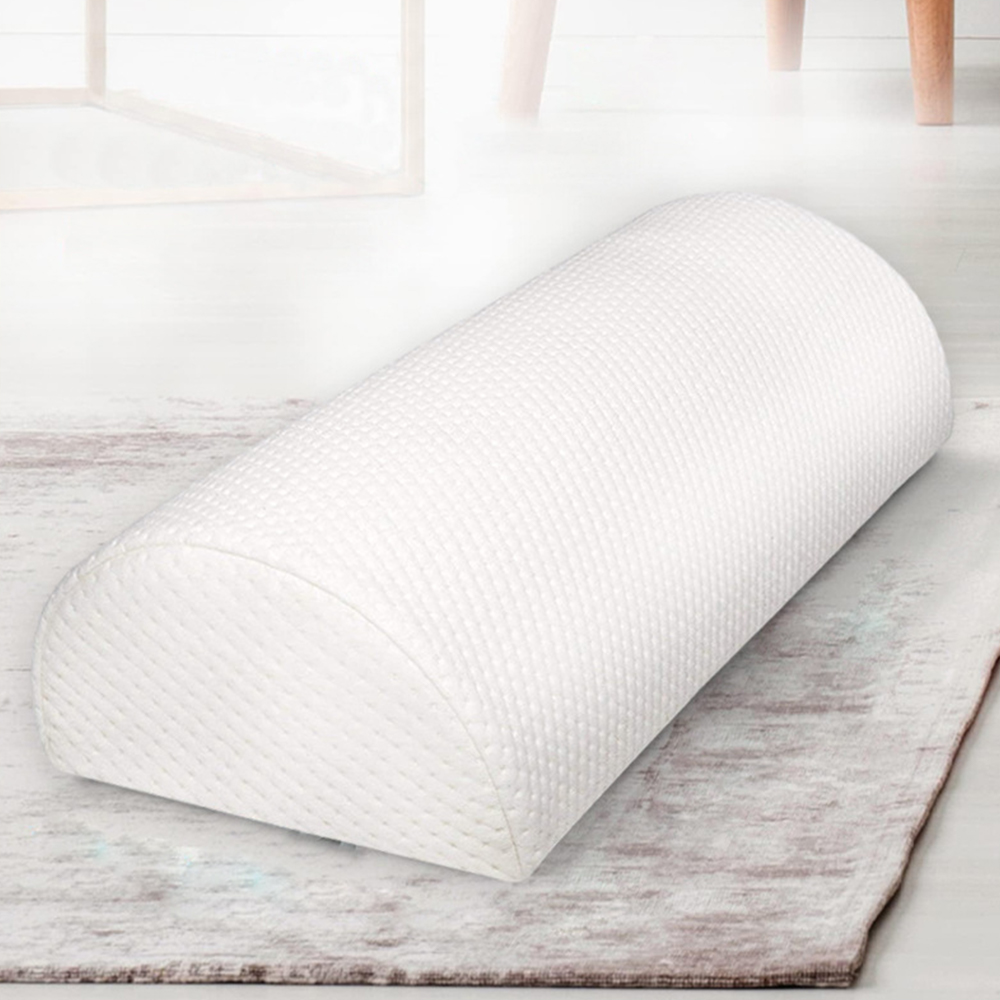
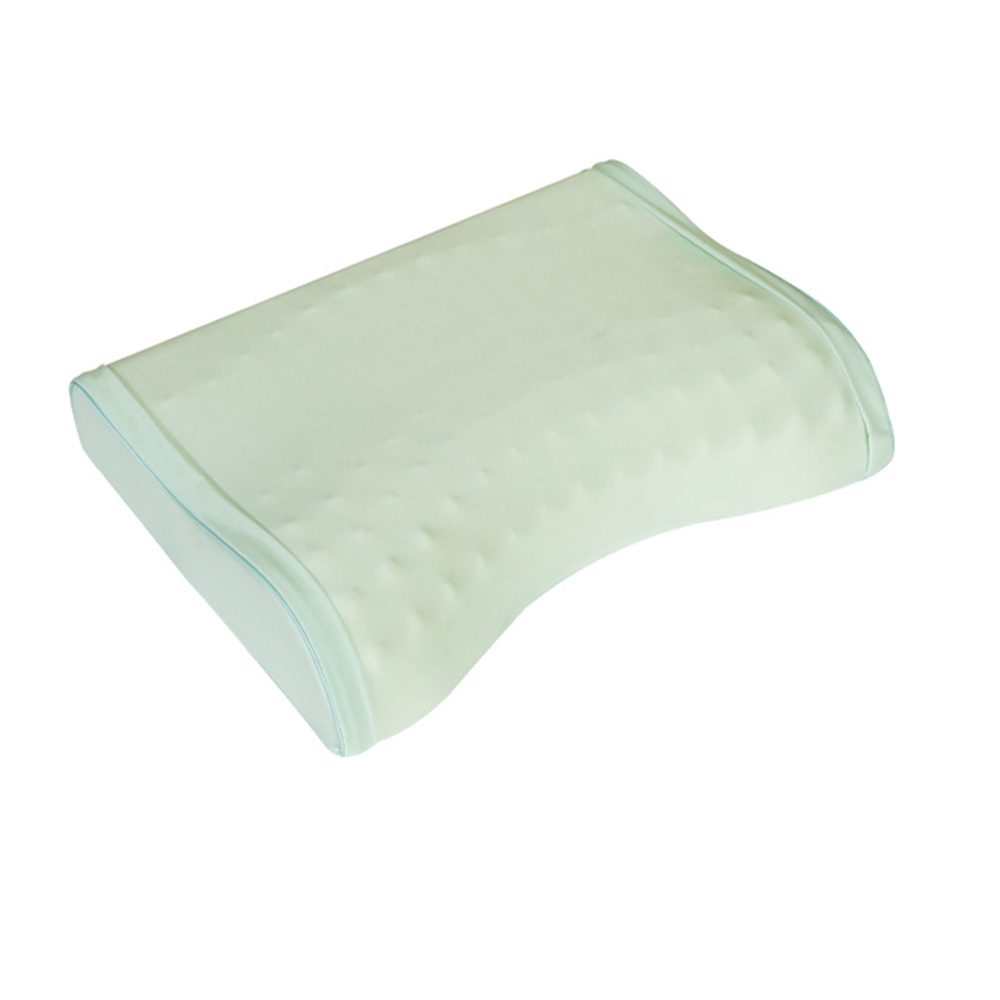
White memory foam leg pillow
1. Product Overview and Core Design
The White Memory Foam Leg Pillow is a semicircular or half-moon-shaped support pillow measuring approximately 52 x 20 x 11 centimeters. The standard pillow core height is 11 centimeters, while the overall dimensions can be customized for different applications. Its shape is deliberately simple: a broad supporting base, a curved upper surface, and a compact footprint that can be placed beneath the lower legs without occupying excessive space.
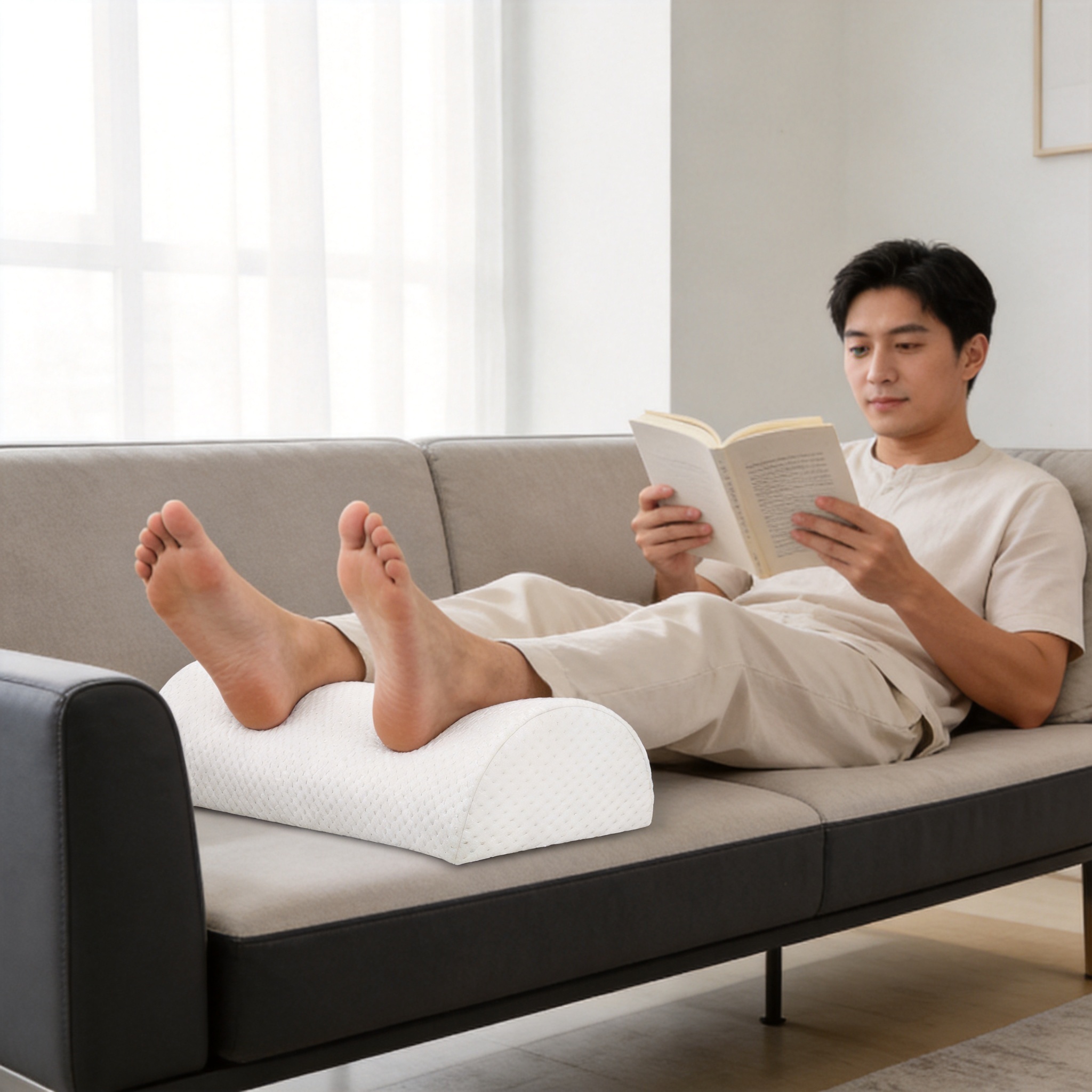
The curved structure is intended to raise the legs gently rather than create an abrupt angle. A gradual elevation of approximately 10°–15° can help users find a more relaxed position while resting. The pillow can be used in bed, on a sofa, under a desk, in a reclining chair, or during travel. Because it does not depend on straps, hinges, pumps, or electrical components, it is easy to position and requires minimal maintenance.
The white exterior gives the product a clean, minimalist appearance. White is widely associated with hygiene, calmness, and modern interior styling, which makes the pillow suitable for bedrooms, wellness spaces, clinics, hotel rooms, postpartum care areas, and contemporary living rooms. Although the standard visual concept is white, the product supports customized colors and fabrics for buyers who need brand coordination or a specific retail appearance.
The product is categorized as a functional pillow and memory foam leg pillow. It is designed primarily for adults and single-person use, although its size and firmness can be adapted for different users. It may be used as a lower-leg support pillow, calf pillow, ankle elevation cushion, relaxation pillow, or sleep aid. It should not be considered a medical device or a substitute for professional medical advice, especially when swelling, pain, circulation problems, or postoperative symptoms are severe or persistent.
2. The Role of Slow-Rebound Memory Foam
The primary functional material is memory foam, also known as viscoelastic foam. This material responds gradually to body heat and pressure. When the legs rest on the pillow, the foam compresses in a controlled manner and conforms to the contours of the calves and ankles. When the load is removed, it slowly returns toward its original shape.
This slow-rebound behavior creates several practical advantages. First, it distributes pressure over a wider area instead of concentrating it at a few contact points. Second, it helps reduce the sensation of hard contact between the legs and the support surface. Third, it offers a more stable experience than loose fiber filling, which can migrate or form uneven areas over time.
A high-density memory foam core can also help the pillow retain its structural profile during repeated use. A low-quality cushion may collapse under the weight of the legs, forcing the user to replace or reshape it frequently. A well-formulated memory foam core is better suited to products that must provide consistent support throughout the night, during office breaks, or through extended recovery periods.
The foam’s ability to conform does not mean that it becomes unstable. The objective is a balance between softness and support. If a pillow is excessively soft, the legs may sink too deeply and lose the intended elevation. If it is too firm, the surface may feel rigid and create uncomfortable pressure. The memory foam formulation, density, thickness, and surface structure must therefore be selected together.
Jiangsu Wellcare Household Articles Co., LTD. has experience developing multiple foam types, including ordinary sponge, memory foam, gel foam, temperature-insensitive memory foam, quick-dry memory foam, flame-retardant sponge, and antibacterial sponge. This broader material knowledge is valuable because functional pillow performance depends not only on the shape of the product, but also on how the foam behaves under different temperatures, humidity conditions, user weights, and usage patterns.
3. Ergonomic Leg Elevation and Support
The main ergonomic feature of the pillow is its gentle elevation. The curved surface raises the lower legs while supporting the calves and ankles. This can help users adopt a more relaxed position after long periods of sitting or standing. When the legs are positioned slightly higher, many users experience a reduction in the feeling of heaviness associated with daily fatigue.
For office users, the pillow can be placed beneath the legs during a break or beneath the calves while reclining at home. For people who stand for long periods, it can provide a comfortable support position after work. During sleep, it can be placed under the lower legs to create a gentle elevation, provided that the position feels comfortable and does not cause numbness or strain.
The pillow can also support a more balanced rest posture. Instead of allowing the legs to remain completely flat or unsupported, the semicircular shape fills the space beneath the calves. This may reduce the need for frequent repositioning. The support surface is broad enough to provide a stable foundation while remaining compact enough for use in smaller spaces.
Users may position the pillow in different ways depending on their personal needs. It can be placed under both calves, under one leg, beneath the ankles, or closer to the knees. The correct position should feel stable and comfortable. Individuals recovering from surgery, managing diagnosed circulation conditions, or experiencing significant swelling should consult a qualified healthcare professional before using an elevation product.
The 10°–15° elevation range is intentionally moderate. It provides a noticeable lift without creating the steep angle associated with large wedge cushions. This makes the product easier to integrate into normal rest routines. It can be combined with a mattress, sofa cushion, recliner, or office chair without requiring major changes to the surrounding furniture.
4. Breathable Cover and Surface Comfort
The pillow is covered with breathable mesh fabric. Breathability is especially important for a product that may remain in contact with the legs for extended periods. A non-breathable cover can trap warmth and moisture, making the user uncomfortable during sleep or in warm climates. Mesh fabric helps promote airflow across the surface while creating a soft and delicate touch.
The cover also contributes to the product’s visual and functional quality. A smooth, clean cover complements the minimalist white design and makes the pillow appropriate for modern interiors. For commercial buyers, the cover can be customized according to the intended market. Options may include different colors, textures, fabric compositions, zipper arrangements, labels, and packaging presentations, subject to production discussion.
A removable or serviceable cover structure may also be considered during customization. Buyers supplying hotels, clinics, senior-care facilities, or wellness centers may require a cover that is easy to clean and maintain. E-commerce brands may prefer a premium knitted cover, a cooling fabric, a branded woven label, or packaging that communicates a stronger lifestyle identity.
Because the cover is the part that comes into direct contact with the user, material selection should consider softness, abrasion resistance, color stability, breathability, and cleaning requirements. The appropriate fabric depends on the intended market and product positioning. A home-use pillow may prioritize touch and appearance, while a professional care environment may prioritize durability and maintenance efficiency.
5. Product Advantages Compared with Ordinary Leg Cushions
5.1 More Consistent Support Than Loose-Fill Cushions
Many inexpensive leg cushions are filled with polyester fiber, shredded foam, or other loose materials. These fillings may feel soft at first, but they can shift under repeated use. The cushion may become uneven, develop thin areas, or require frequent manual adjustment. By contrast, a shaped memory foam core provides an integrated support structure that remains more consistent across the product surface.
The memory foam design is particularly useful when users want a predictable elevation angle. A loose-fill pillow may compress at different rates depending on where the legs are placed. The half-moon memory foam structure is more likely to maintain the intended curved profile and support position.
5.2 More Compact Than Large Wedge Supports
Large leg wedges can provide substantial elevation, but they may take up considerable bed or sofa space. They can also be difficult to transport, store, or use in a small apartment. The White Memory Foam Leg Pillow uses a compact 52 x 20 x 11 centimeter format, making it easier to move between rooms and practical for travel or office use.
Its smaller profile is an advantage for customers who want functional support without purchasing a large medical-style wedge. It can be stored beside a bed, under a desk, in a closet, or in the trunk of a vehicle. Custom sizing also allows buyers to create a smaller travel version or a broader support format for users who prefer greater leg coverage.
5.3 A More Balanced Alternative to Very Firm Blocks
Rigid foam blocks may provide elevation but can feel uncomfortable around the calves and ankles. Their hard edges or fixed surfaces may create pressure points. Memory foam offers a more adaptive interface, allowing the surface to respond to the shape of the legs while the core maintains the overall structure.
This balance between conformity and support is one of the product’s key competitive features. The pillow is not simply soft, and it is not simply rigid. It is designed to provide cushioning while retaining a defined ergonomic form.
5.4 Cleaner Visual Integration
Some functional supports have a strongly clinical appearance that does not blend easily with home décor. The white, minimalist design of this pillow is intended to fit naturally into bedrooms, living rooms, offices, vehicles, and hospitality environments. Its appearance allows it to serve a wellness function without becoming visually dominant.
5.5 Greater Customization Potential
Many mass-market pillows are available only in one shape, one color, and one cover material. This product supports customization of size, color, fabric, and related processing requirements. That flexibility is valuable for wholesalers, private-label sellers, hotel suppliers, rehabilitation product distributors, and online brands that need product differentiation.
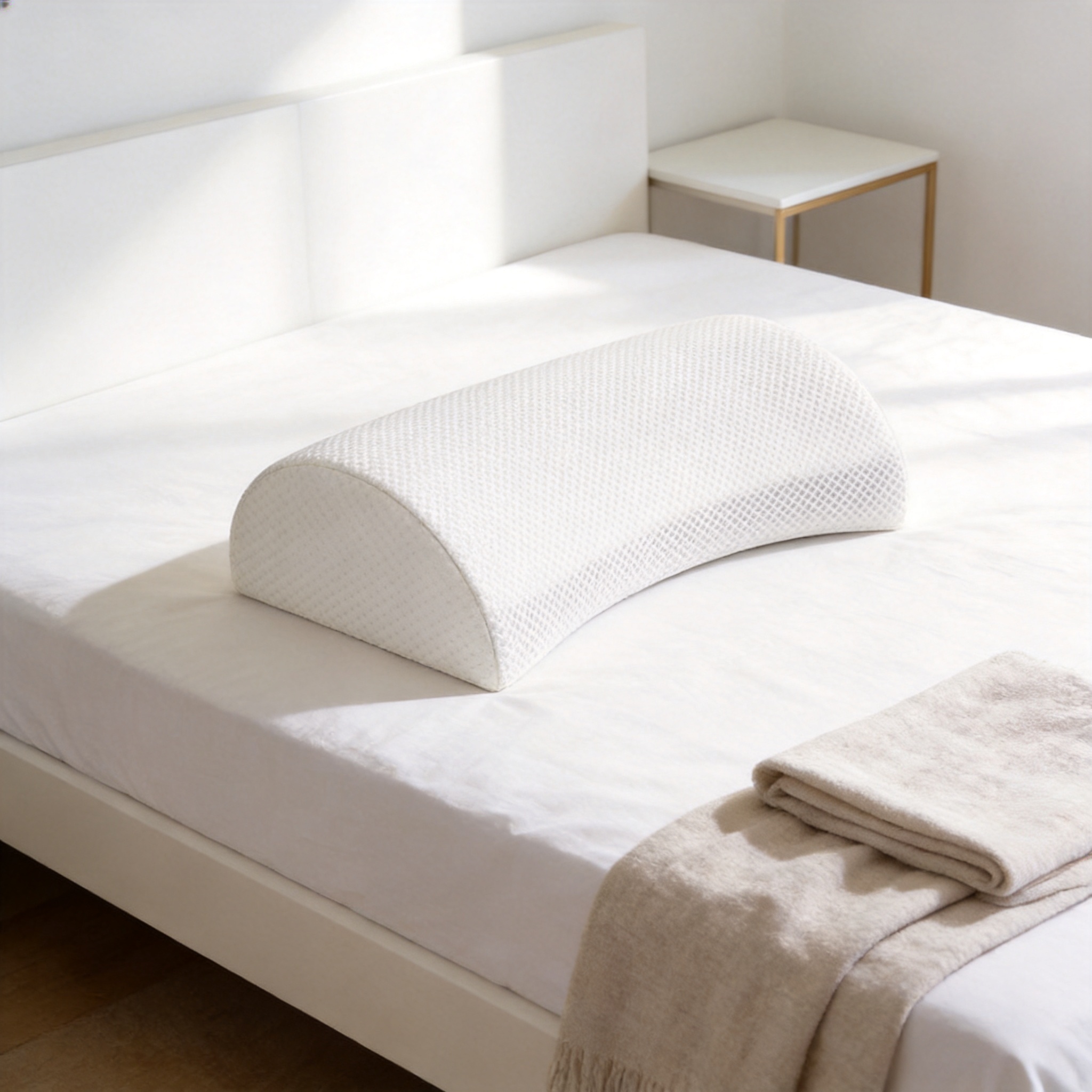
6. Applications in Daily Life and Professional Settings
6.1 Home Relaxation
At home, the leg pillow can be placed on a bed, sofa, recliner, or floor mat. It can support the legs while reading, watching television, working on a laptop, or resting after household activities. The compact form allows users to move it easily between the bedroom and living room.
6.2 Office and Work-from-Home Use
People who sit for long periods may use the pillow during breaks or while reclining after work. It can also be positioned beneath the lower legs when a user is working from a sofa or adjustable chair. Because it is lightweight, it can be stored under a desk when not in use.
6.3 Postpartum Recovery
After childbirth, some users appreciate additional lower-leg support during periods of rest. The gentle elevation may make sitting or lying down feel more comfortable. The product’s breathable cover and soft memory foam surface are suitable for a calm home recovery environment. Postpartum users should follow the recommendations of their healthcare providers, particularly when experiencing unusual swelling or pain.
6.4 Postoperative and Rehabilitation Environments
Some people use leg support products during postoperative recovery or rehabilitation. A functional pillow can help create a stable resting position and reduce the need to hold the legs manually. However, the appropriate angle and placement depend on the procedure and the individual’s condition. The product should be used as a comfort accessory, not as a replacement for clinical instructions.
6.5 Travel and Vehicle Use
The pillow’s lightweight structure makes it suitable for travel. It can be used on long journeys, in hotel rooms, or in temporary accommodation. It may also be used in a vehicle when the passenger has sufficient space and the position does not interfere with seat belts, driving controls, or safe vehicle operation. The product should never obstruct the driver or be used in a way that compromises travel safety.
6.6 Hospitality and Wellness Businesses
Hotels, spas, massage studios, wellness centers, and recovery-focused accommodation providers can use customized functional pillows as part of a comfort package. A branded cover and coordinated color can help create a consistent guest experience. The compact size also makes the pillow easy to store and distribute in rooms or treatment areas.
6.7 Retail and E-Commerce Products
For online sellers, the product has several features that are easy to communicate: memory foam construction, semicircular support, gentle leg elevation, breathable mesh, compact dimensions, and customizable design. Its practical size can simplify packaging and storage compared with large wedge products. It can be positioned as a wellness accessory, sleep-support product, recovery cushion, or ergonomic home comfort item.
7. Materials, Safety, and Quality Considerations
The filling material is memory foam, while the pillow core fabric is listed as polyester fiber. The product uses materials selected for comfort, resilience, and practical manufacturing. The memory foam provides the primary support function, while the cover and core construction contribute to stability, surface feel, and durability.
The product information identifies OEKO-TEX® certification as a material safety feature. Textile-related certification can help buyers evaluate whether tested materials meet defined limits for certain substances. For commercial customers, certification documentation should be confirmed for the specific production batch, fabric, foam system, and finished product required for the order.
A safe product approach involves more than selecting a certified fabric. Manufacturers should consider foam formulation, curing, odor management, dimensional stability, cover performance, packaging, and storage conditions. Foam products can retain manufacturing odors if they are packaged too quickly or stored without adequate ventilation. Proper production control and post-production handling can help improve the customer’s initial experience.
Quality inspection may include checking dimensions, foam density, rebound behavior, compression recovery, cover stitching, zipper performance, color consistency, surface defects, and packaging integrity. For customized orders, inspection criteria should be agreed upon before production. This is especially important when the product is sold under a private label or supplied to a large retail platform.
The product is designed for adults and single-person use. Buyers should select dimensions and firmness according to the intended user group. A standard household product may not be suitable for every medical, pediatric, bariatric, or specialized rehabilitation application. If a buyer requires a special load-bearing capacity or a particular clinical use, the design and testing requirements should be discussed during product development.
8. Customization Options for Business Buyers
Customization is one of the strongest commercial advantages of this product. The standard dimensions are approximately 52 x 20 x 11 centimeters, but custom sizing is available. A retailer may request a shorter version for travel, a wider version for two-leg coverage, a taller version for increased elevation, or a special format compatible with a particular chair or bed system.
Color customization allows the pillow to match a brand identity, bedding collection, hotel interior, or seasonal product line. White provides a clean default appearance, but gray, beige, blue, green, black, and other colors may be considered depending on the fabric and production requirements.
Fabric customization can change the tactile quality, airflow, appearance, and maintenance profile of the product. Buyers may request breathable mesh, knitted textile, cooling fabric, antibacterial fabric, moisture-management material, or other suitable options. Fabric selection should be evaluated together with the intended climate, user group, cleaning method, and price target.
Branding options may include woven labels, printed labels, packaging sleeves, cartons, instruction cards, hangtags, and private-label presentation. Since the company supports authorized own-brand availability, buyers can explore branded product programs rather than selling an unbranded commodity item.
Packaging is also an important part of customization. A compact pillow can be packed in an individual retail box, vacuum-compressed packaging, a reusable fabric bag, or bulk cartons for wholesale distribution. The packaging method must be selected carefully because compression can affect the recovery time and first-use experience of memory foam. Product instructions should explain how long the pillow may need to regain its intended shape after unpacking.
For dropshipping businesses and cross-border sellers, the supplier’s experience with international e-commerce requirements can help simplify procurement. Buyers should still confirm carton dimensions, shipping weight, labeling rules, import requirements, packaging standards, and marketplace policies for each destination.
9. Manufacturing Strengths and Technical Background
Jiangsu Wellcare Household Articles Co., LTD. was founded in 2003 and focuses on the research, development, and manufacture of high-performance sleep materials and healthy home products. Its product range includes foam materials, mattresses, memory foam pillows, functional pillows, cushions, pet products, and other household comfort products.
The company’s material development capability is supported by a doctor-led research and development team. According to the provided company information, the team develops more than one hundred new foam materials each year. This level of ongoing experimentation indicates a strong focus on formulation research, performance optimization, and application-specific material design.
Foam development is a technical process involving polymer chemistry, cell structure, density, resilience, compression behavior, temperature response, airflow, odor control, durability, and manufacturing stability. Different applications require different balances. A mattress may require pressure distribution across a large surface, while a leg pillow requires a compact shape that can support a concentrated load without becoming excessively firm.
The company’s product portfolio includes ordinary sponge, memory foam, gel foam, temperature-insensitive memory foam, quick-dry memory foam, flame-retardant sponge, antibacterial sponge, and other specialized materials. This portfolio allows the manufacturer to evaluate different material solutions for various climates, customer expectations, safety requirements, and price levels.
The company’s development history began in 1993 as a school-run scientific research enterprise. In 2003, it purchased a 12,000-square-meter factory building and jointly developed new sponge materials with Huai’an Institute of Technology. In 2008, it purchased 50,000 square meters of land. These milestones demonstrate a long-term effort to combine industrial production with technical collaboration.
By 2010, the company was supplying products to cross-border supermarkets in the United States, Germany, and Japan. It later exported products to the United Kingdom, Canada, Australia, and Kuwait. This international experience is relevant to buyers who need a supplier familiar with overseas quality expectations, packaging requirements, communication procedures, and commercial delivery schedules.
In 2018, the company became an Alibaba-certified Gold Supplier and entered the e-commerce sector. In 2020, it became a designated supplier for five-star hotels. These developments reflect experience serving both online business channels and professional hospitality customers.
10. Advanced Manufacturing Process
10.1 Material Research and Formula Selection
Production begins with selecting a foam formulation that matches the required product performance. For a leg pillow, the manufacturer must consider pressure response, shape retention, rebound speed, density, ventilation, temperature behavior, and user comfort. The selected formula should provide sufficient support while preserving the soft, conforming feel associated with memory foam.
10.2 Foam Production and Curing
Foam production requires accurate control of raw material ratios, mixing conditions, expansion behavior, cell formation, and curing time. Variations in these stages can affect the final density, firmness, resilience, and dimensional stability. Proper curing is especially important because insufficiently cured foam may have stronger odor, inconsistent performance, or reduced durability.
10.3 Shaping and Profile Control
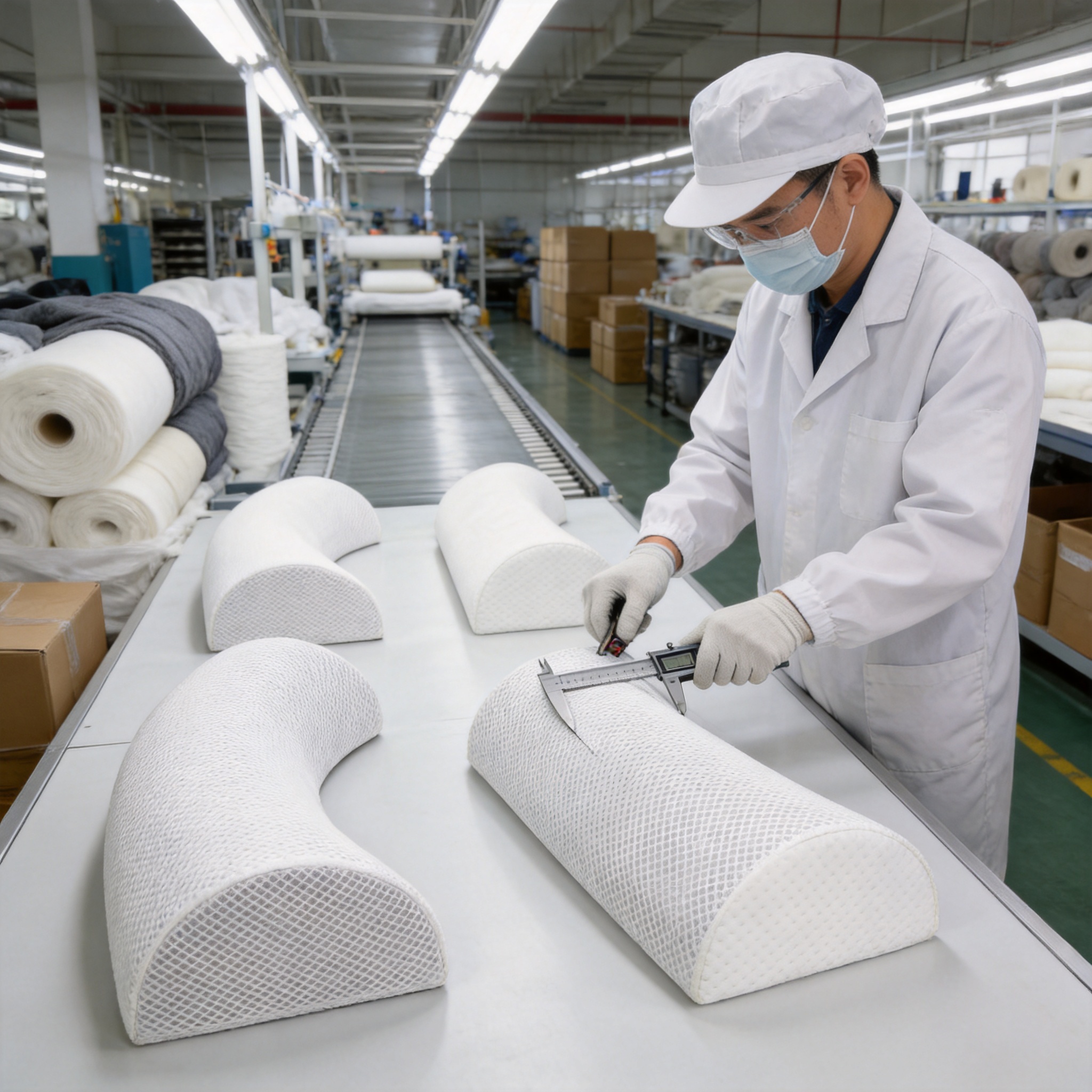
After the foam is produced and stabilized, it can be shaped into the semicircular leg pillow profile. The curved surface and 11-centimeter core height should remain within the agreed dimensional tolerances. Consistent shaping ensures that different units in the same batch provide a similar user experience.
10.4 Surface and Edge Finishing
The pillow’s edges and contact surfaces should be finished smoothly. Uneven edges can affect appearance and comfort, while rough or irregular areas may create difficulties during cover installation. Appropriate finishing also improves the visual quality expected by retail and hospitality customers.
10.5 Cover Cutting and Sewing
The breathable mesh cover is cut according to the final foam dimensions and sewn to provide a clean fit. Stitch quality, seam strength, zipper alignment, and fabric tension all influence the finished product. A well-fitted cover helps preserve the intended shape and prevents excessive movement between the fabric and foam core.
10.6 Inspection and Packaging
Finished products can be inspected for appearance, dimensions, foam recovery, cover quality, labeling, and packaging. Packaging must protect the pillow from contamination, moisture, compression damage, and shipping abrasion. For international orders, packaging may also need to meet retailer, warehouse, or platform requirements.
This integrated manufacturing process is an advantage over suppliers that purchase generic foam and simply place it inside a basic cover. A manufacturer with in-house material knowledge can better coordinate formulation, shape, cover, customization, and quality control.
11. Sustainability and Environmental Responsibility
Modern buyers increasingly evaluate not only product comfort and price, but also the environmental practices of the supplier. Jiangsu Wellcare Household Articles Co., LTD. has identified sustainability as an important part of its development strategy. The company invests in advanced eco-friendly energy systems and continues to improve environmental management practices.
Responsible foam manufacturing involves attention to resource use, production efficiency, waste reduction, energy consumption, emissions management, packaging selection, and product durability. A product that retains its shape and remains useful for a longer period may reduce the frequency of replacement. Durable design is therefore relevant to both customer value and environmental impact.
Material safety and environmental responsibility should be considered together. Buyers may request information about applicable certifications, foam composition, fabric specifications, packaging materials, production controls, and waste-management practices. The exact documentation available will depend on the product version, destination market, and order requirements.
For private-label customers, sustainability information can also support responsible marketing. However, environmental claims should be based on verifiable documentation and should accurately describe the specific product rather than making broad unsupported statements.
12. Quality and Commercial Advantages for Distributors
Distributors and retailers need products that are practical to store, easy to explain, reliable in use, and adaptable to different sales channels. The White Memory Foam Leg Pillow offers a combination of compact dimensions, recognizable function, and customizable presentation.
Its small footprint can reduce storage requirements compared with large orthopedic wedges. The product can be displayed in bedding departments, wellness sections, home-care catalogs, office comfort collections, travel-accessory stores, and online marketplaces. The simple shape also makes it easy to photograph and demonstrate in product listings.
The product’s benefit structure is straightforward. Customers can understand that it supports the lower legs, provides gentle elevation, conforms to the body, and offers a breathable surface. Clear benefit communication is useful in e-commerce because shoppers often compare several similar cushions based on material, shape, size, firmness, cover, and appearance.
Custom manufacturing provides additional differentiation. A distributor can create a unique size or fabric rather than competing solely on price with identical generic products. A brand can also develop a coordinated product family that includes memory foam pillows, seat cushions, mattresses, pet cushions, and other home comfort items.
Wellcare’s support for dropshipping, cross-border export supply, authorized own-brand availability, and custom processing can help businesses select a supply model appropriate to their stage of development. A small online seller may begin with standard products, while an established brand may require custom sizes, packaging, and scheduled production.
13. User Guidance and Care Recommendations
When first unpacked, a memory foam pillow may require time to recover its full shape, particularly if it has been compressed for transportation. It should be placed in a well-ventilated area and allowed to expand according to the supplier’s instructions. Users should avoid applying excessive force during the recovery period.
The pillow should be placed on a stable surface. On a bed or sofa, it should not slide into a position that causes the legs to fall awkwardly. Users should adjust the pillow so that the calves or ankles are supported evenly and the knees remain comfortable. If numbness, increased pain, or unusual discomfort occurs, use should be discontinued until the position can be evaluated.
The cover should be cleaned according to its care label. If the cover is removable, it should be washed using the recommended temperature and method. The foam core generally should not be soaked unless the manufacturer provides specific instructions. Excess moisture can affect foam performance and may increase drying time.
The product should be stored in a dry, ventilated location away from sharp objects, direct heat, and prolonged sunlight. It should not be folded, cut, or exposed to flames. Proper care can help preserve the shape, cover quality, and overall service life of the pillow.
14. Buyer Selection Checklist
When evaluating a memory foam leg pillow, buyers should consider more than appearance. The foam density and support behavior should be suitable for the target users. The elevation angle should be comfortable rather than excessively steep. The cover should match the expected climate, contact time, cleaning requirements, and retail price position.
Dimensions should also be reviewed carefully. The standard 52 x 20 x 11 centimeter format is compact, but some users may need a wider support area or a different height. Retail buyers should assess packaging dimensions, shipping weight, carton quantity, warehouse stacking, and product display requirements.
For custom projects, buyers should confirm minimum order quantities, sampling procedures, development fees, production lead times, color standards, fabric availability, labeling, packaging, inspection requirements, and delivery terms. They should also establish whether custom specifications apply to every order or only to a particular production run.
Documentation should be matched to the destination market. This may include material information, safety test reports, textile certifications, packaging details, product labels, care instructions, and country-specific compliance documentation. Requirements differ across regions, so buyers should define them before production begins.
| Evaluation Area | Recommended Consideration | Product Relevance |
| Core material | Memory foam with stable support and gradual rebound | Helps the pillow conform to the legs while retaining its shape |
| Shape | Semicircular or half-moon profile | Supports the calves and ankles and provides gentle elevation |
| Elevation | Approximately 10°–15° | Creates a moderate resting angle without a bulky wedge |
| Standard size | Approximately 52 x 20 x 11 centimeters | Compact for bedrooms, offices, travel, and retail storage |
| Surface | Breathable mesh fabric | Improves airflow and surface comfort |
| Customization | Size, color, fabric, label, and packaging options | Supports private-label and channel-specific product development |
| Safety positioning | OEKO-TEX® certified material information as applicable | Supports responsible material selection and market communication |
| Supply capability | Custom processing, dropshipping, and cross-border supply | Offers flexibility for distributors and e-commerce businesses |
15. Why Manufacturing Experience Matters
A functional pillow may appear simple, but consistent quality depends on coordinated decisions across materials, design, production, and inspection. A supplier with only basic sewing capability may not be able to optimize foam performance. A foam producer without finished-product experience may not understand cover fit, packaging, or retail presentation. The strongest results come from integrating these capabilities.
Wellcare’s history in foam research and healthy home products provides a foundation for this integrated approach. Its experience covers both raw material development and finished goods. This can make communication more efficient when a buyer needs to adjust firmness, shape, size, rebound behavior, fabric, or packaging.
The company’s cooperation with educational and research institutions also supports a technical culture. Development partnerships can help manufacturers investigate new formulas, refine production methods, and respond to changing market preferences. This is particularly relevant as consumers seek products that are more breathable, temperature-stable, hygienic, durable, and environmentally responsible.
International supply experience is another advantage. Products intended for North America, South America, Southeast Asia, Europe, Australia, and other markets may face different climate conditions, consumer expectations, labeling needs, logistics routes, and retail standards. A supplier accustomed to cross-border business is better positioned to discuss these factors during product planning.
16. Frequently Asked Questions
Q1: What is the main purpose of the White Memory Foam Leg Pillow?
The pillow is designed to support the calves and ankles while gently elevating the legs. It can help create a more comfortable resting position after prolonged sitting, standing, travel, daily activity, postpartum recovery, or certain postoperative periods. It is a comfort and support product, not a medical treatment.
Q2: What makes the pillow different from a standard fiber-filled cushion?
The pillow uses a shaped memory foam core rather than relying only on loose filling. Memory foam gradually conforms to the body, distributes pressure, and is designed to retain a stable form during repeated use. A fiber-filled cushion may be softer initially but can shift or flatten more easily.
Q3: What is the standard product size?
The listed standard size is approximately 52 x 20 x 11 centimeters. Custom sizes are available, so buyers can discuss alternative dimensions for travel, retail, hospitality, rehabilitation, or private-label applications.
Q4: How high does the pillow elevate the legs?
The curved structure is designed to raise the legs by approximately 10°–15°. The actual user experience can vary according to leg position, body size, mattress softness, and placement. Users should adjust the pillow to achieve a comfortable and stable posture.
Q5: Is the cover breathable?
Yes. The product is described as having a breathable mesh fabric cover. Breathability helps improve airflow and surface comfort, especially during extended use. Custom fabric options may also be discussed for different climates and market requirements.
Q6: Can the product be customized?
Yes. The product supports customization of size, color, and fabric. Buyers may also discuss labels, packaging, branding, and other custom processing requirements with the manufacturer.
Q7: Is the product suitable for postoperative use?
It may be used as a comfort support during some recovery periods, but the correct position depends on the individual’s condition and medical instructions. Anyone recovering from surgery should consult a healthcare professional before using a leg elevation product.
Q8: Can the pillow be used during sleep?
It can be used as a sleep-support accessory if the user finds the position comfortable and stable. The pillow should not cause numbness, pain, pressure, or restricted movement. Users should adjust or discontinue use if discomfort occurs.
Q9: What materials are used in the product?
The filling material is memory foam, and the listed pillow core fabric is polyester fiber. The exterior is described as breathable mesh fabric. Specific custom materials should be confirmed for each order.
Q10: Is the product available for private-label brands?
Authorized own-brand availability is supported. Buyers can discuss customized colors, fabrics, labels, packaging, sizes, and other specifications for a branded product program.
Q11: Does the supplier support dropshipping?
Yes. The product information indicates that dropshipping is supported. Buyers should confirm order handling, packaging, labeling, fulfillment procedures, and destination requirements before starting a dropshipping program.
Q12: Which sales regions does the supplier serve?
The listed main sales regions include South America, Southeast Asia, and North America. The company also has export experience involving markets such as the United Kingdom, Canada, Australia, Germany, Japan, and Kuwait.
Q13: Can the pillow be used in a car?
Its compact design makes it suitable for some passenger-seat or rest situations, provided there is sufficient space and it does not interfere with seat belts, driving controls, or safe vehicle operation. It should not be used in a way that compromises vehicle safety.
Q14: How should the pillow be cleaned?
The cover should be cleaned according to its care label. The foam core should be protected from unnecessary moisture and should not be soaked unless the manufacturer provides specific instructions. Buyers should request detailed care guidance for customized fabric versions.
Q15: What should wholesale buyers confirm before ordering?
Wholesale buyers should confirm dimensions, firmness, foam specifications, fabric, color, branding, packaging, minimum order quantity, sample approval, production schedule, inspection requirements, shipping terms, and destination-market documentation.
17. Conclusion
The White Memory Foam Leg Pillow combines a compact semicircular design with slow-rebound memory foam, breathable mesh fabric, and gentle 10°–15° leg elevation. It is designed to provide stable support for the calves and ankles while helping users create a more comfortable resting posture. Its clean white appearance and versatile dimensions allow it to fit into bedrooms, offices, living rooms, vehicles, hotels, wellness spaces, and recovery environments.
Compared with ordinary loose-fill cushions, rigid blocks, and oversized wedges, the product offers a useful balance of conformity, support, portability, and visual simplicity. Its standard size is practical for storage and transport, while its custom manufacturing options allow buyers to develop a more distinctive product for their own market.
The product’s commercial value is strengthened by the manufacturing background of Jiangsu Wellcare Household Articles Co., LTD. The company’s experience in foam research, memory foam development, specialized material formulation, finished-product manufacturing, international supply, e-commerce, hospitality, and sustainability provides a strong foundation for consistent product development.
For consumers, the pillow offers a practical way to improve lower-leg comfort during everyday rest. For businesses, it offers a customizable platform for wellness, sleep, home-care, hospitality, and e-commerce applications. With appropriate material selection, careful production control, and clear usage guidance, this functional pillow can become a dependable addition to modern healthy-home product lines.
References
1. Product specification and application information for the White Memory Foam Leg Pillow, including dimensions, materials, elevation design, customization options, and target applications.
2. Company profile and manufacturing history of Jiangsu Wellcare Household Articles Co., LTD.
3. General technical literature on viscoelastic memory foam, pressure distribution, rebound behavior, density, and comfort performance.
4. General guidance on ergonomic leg support, resting posture, and lower-limb elevation.
5. OEKO-TEX® textile safety and material certification information.
6. General industry references concerning foam manufacturing, curing, shaping, cover fabrication, quality inspection, and packaging.
7. General guidance from healthcare professionals regarding postoperative recovery, postpartum comfort, circulation concerns, and the appropriate use of elevation supports.
Product: White memory foam leg pillow
PREV:Grooved Memory Foam Leg Pillow: Ergonomic Elevation, Portable Comfort, and Reliable Manufacturing
NEXT:Memory Foam Massage Pillow: Cooling Comfort, Cervical Support, and Reliable Manufacturing
NEXT:Memory Foam Massage Pillow: Cooling Comfort, Cervical Support, and Reliable Manufacturing
Interested in cooperation or have questions?
Related News
WELLCARE was founded in 2003, boasting over a decade of profound and extensive experience.
Quick Links
Product
Media Centre
Contact Information
- wesley@wellcare-mattress.com
- +86-517-84998062
- +86-15152354988
- No. 168 Nenjiang Road, Huaiyin District, Huai'an City, Jiangsu Province, China
Copyright © Jiangsu Wellcare Household Articles Co., LTD. All Rights Reserved.
Custom Memory Gel Mattress Manufacturers
